Nexelec VIGAS Battery-Powered Natural Gas Alarm, 10-Year Sealed Battery, NYC Local Law 157 (K987GL)
Price: $78.00 per each
| 1–99 units | $78.00 |
| 100–1,999 units | $74.00 |
| 2,000+ units | $69.95 |
Availability: Ships within 1-3 business days
Specifications
| Brand | Nexelec |
|---|---|
| Manufacturer Part Number | K987GL |
| Part Number | K987GL |
| SKU | NEX-K987GL |
| Category | Gas |
Weight: 0.75 lb
Description
The Nexelec VIGAS (model K987GL) is a battery-powered residential natural gas alarm built for New York City's Local Law 157 requirement, which obliges owners of residential buildings with gas service to have natural gas alarms installed by January 1, 2027. It continuously monitors the air for natural gas (methane, CH4) and sounds an 85 dB alarm with a visual LED warning when the concentration reaches 10% of the Lower Explosive Limit (LEL) - one-tenth of the level at which gas can ignite, so occupants are warned well before a leak becomes dangerous. It is ETL Listed by Intertek and conforms to UL 1484, the listing standard NYC requires for natural gas alarms. A sealed lithium battery is designed to run the alarm for its full 10-year service life: there is no wiring, no outlet and no battery to change, so a super, a handyman or the tenant can mount it in minutes.
HOW IT WORKS
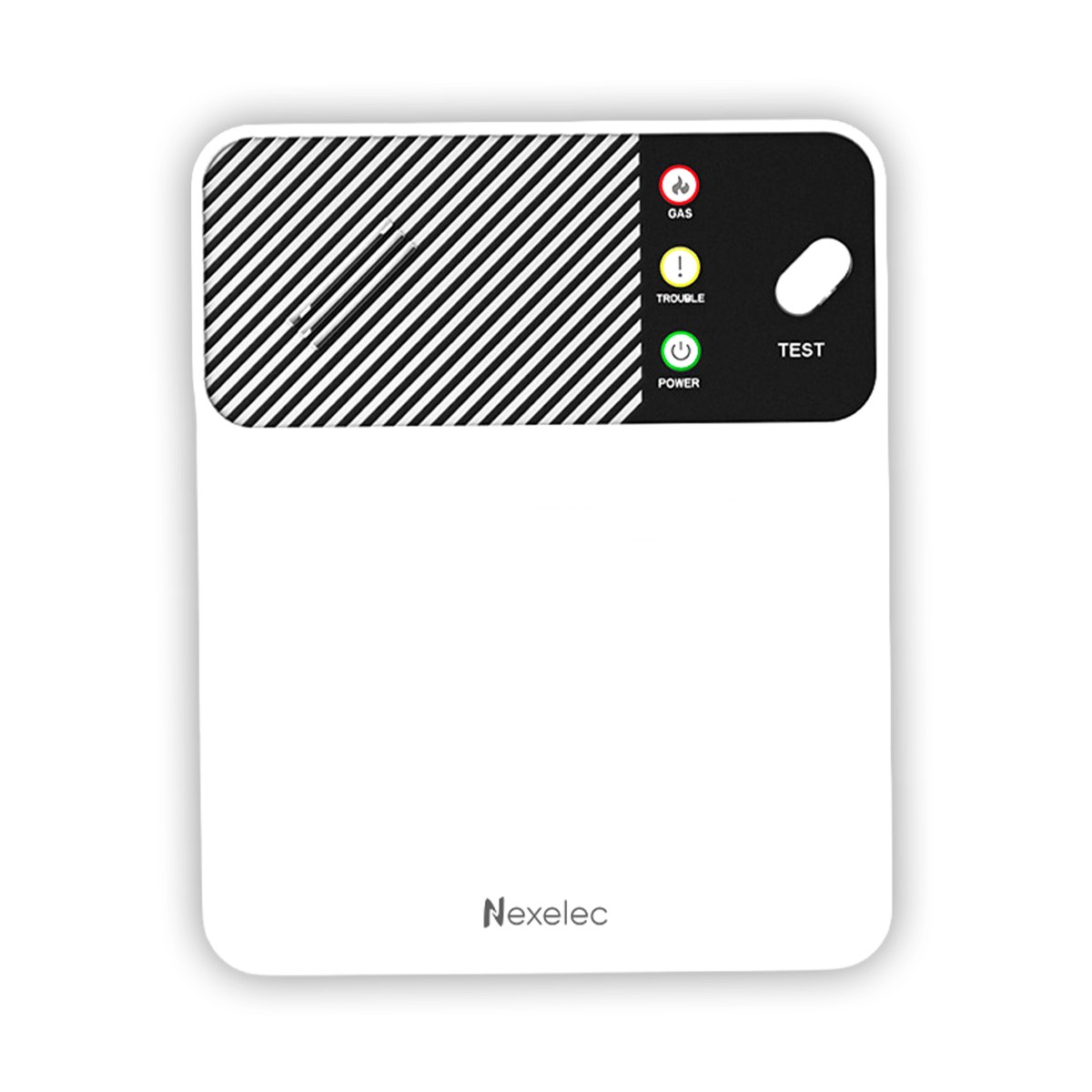
VIGAS uses a MEMS thermoelectric semiconductor sensor designed for stable natural gas detection. When methane reaches the 10% LEL alarm threshold, the unit sounds an 85 dB alarm (measured at 10 feet / 3 meters) and lights its red GAS indicator. A three-color LED panel shows GAS (alarm), TROUBLE (sensor or device fault) and POWER (normal operation) at a glance. The front Test/Hush button runs a functional test and temporarily silences an alarm, as described in the User Guide. Built-in supervision gives a low-battery warning when battery voltage gets too low, a fault warning if the sensor or electronics malfunction, and an end-of-life warning when the alarm reaches the end of its service life.
BUILT FOR BUILDING PORTFOLIOS
Every VIGAS carries a QR code and works with Nexelec's NAVIXIS platform, a digital logbook for tracking the installation and maintenance of a whole fleet of gas alarms - useful for owners and managing agents who must keep Local Law 157 installation and expiration records for every apartment.
SPECIFICATIONS
- Manufacturer: NEXELEC; model VIGAS, reference K987GL
- Gas detected: natural gas (methane, CH4). Does not detect carbon monoxide, smoke or propane.
- Sensor: MEMS thermoelectric semiconductor
- Alarm threshold: 10% LEL
- Alarm: 85 dB at 10 ft (3 m), audible and visual
- Indicators: three-color LED (Gas / Trouble / Power)
- Controls: front Test/Hush button
- Power: sealed, non-replaceable lithium battery, designed for a 10-year service life (battery life is not guaranteed and varies with temperature, testing frequency and alarm events)
- Warnings: low battery, fault detection, end of life
- Mounting: wall-mounted, indoor use only
- Operating temperature: 32°F to 122°F (0°C to 50°C)
- Operating humidity: 5% to 93% RH, non-condensing
- Dimensions: 4.25 in H x 3.46 in W x 1.57 in D (10.8 x 8.8 x 4.0 cm)
- Certification: ETL Listed by Intertek, conforms to UL 1484
- Warranty: 2-year limited manufacturer warranty from the date of purchase (the 10-year figure is the designed service life, not the warranty term)
- In the box: 1 VIGAS natural gas alarm, 2 mounting screws, 2 wall anchors, 1 User Guide
NYC LOCAL LAW 157 - WHAT THE LAW REQUIRES
Local Law 157 of 2016 added natural gas alarms to the detector requirements of the NYC Housing Maintenance Code (Administrative Code §27-2045). The NYC Department of Buildings implements it through rule 1 RCNY §908-02, which adopts NFPA 715 (2023 edition) as amended by 1 RCNY §3616-06.
- Deadline: January 1, 2027. Local Law 102 of 2025 set that date and allowed a possible extension to 2029 only if DOB could not find at least four manufacturers of qualifying battery-powered alarms. On June 15, 2026, DOB announced that it had found them and that the deadline will not be extended beyond January 1, 2027.
- Who must comply: owners of Class A and Class B multiple dwellings and of private dwellings (one- and two-family homes that are not owner-occupied) that have gas piping or gas service - R-1, R-2 and R-3 occupancies. Buildings with no gas piping are exempt, and an apartment with no gas appliance does not need one.
- Where alarms go: in the same room as each gas appliance (range, stove, water heater, dryer and so on), at least 3 feet but no more than 10 feet from the appliance, measured horizontally. When wall-mounted, the alarm must be within 12 inches of the ceiling. If the room is too small for 3 feet, or the manufacturer's instructions or NFPA 715 call for a different spot, follow those instead. Common areas that contain a gas-burning appliance need alarms too, and DOB also requires one in a unit directly above a gas appliance or gas piping. Centralized, restricted boiler or water heater rooms and commercial restaurant kitchens are not covered.
- Battery power is allowed: buildings that received their Certificate of Occupancy (or TCO) before January 1, 2027 may use a battery-powered alarm such as VIGAS. Buildings with a CO issued after that date need AC primary power with secondary power.
- No electrician needed: hardwired alarms must be installed by a NYC Licensed Electrical Contractor with permits, but battery-powered alarms may be installed by the building owner, maintenance staff or the occupant.
- Listing: alarms must be listed and labeled to UL 1484. VIGAS is ETL Listed by Intertek to UL 1484. DOB does not endorse any manufacturer or model.
- Class B alternative: Class B buildings may instead use a centrally monitored, line-operated zoned gas detection system in public corridors and spaces.
OWNER AND TENANT RESPONSIBILITIES (HPD)
The NYC Department of Housing Preservation and Development (HPD) enforces the requirement. Owners must install the alarms, give at least one adult occupant of each apartment a written notice explaining testing, maintenance and what to do when the alarm sounds, post the natural gas detector notice at the building entrance, and keep records of each device's installation date and the expiration date of its manufacturer's suggested useful life. Owners must replace an alarm at the end of its useful life, before a new tenant moves in if the prior tenant did not replace a missing or disabled one, and within 30 days if it fails within the first year through a defect that is not the occupant's fault. In Class A buildings and private dwellings, owners may collect $25 per natural gas alarm from the tenant for the initial installation, payable within one year of installation; Class B tenants pay nothing. Tenants should test the alarm at least once a month, never paint over it, and replace any alarm that is stolen, removed or made inoperable during their tenancy. Because VIGAS has a sealed 10-year battery, there are no batteries to change - replace the whole alarm when the end-of-life warning sounds or by the replacement date printed on the unit.
Please note: installing an alarm does not by itself make a building compliant with Local Law 157. Placement, notices and record keeping are the owner's responsibility; check the current DOB natural gas detector FAQs and HPD detector rules for your building.
ORDERING AND SHIPPING
Ships within 1-3 business days. Free UPS Ground shipping on orders of 10 or more alarms (any order of $500 or more ships free). Ships to the contiguous 48 states and Washington, DC only - we cannot ship this item to Alaska, Hawaii, Puerto Rico or other U.S. territories. Volume pricing is applied automatically in the cart: 1-99 units $78.00 each, 100-1,999 units $74.00 each, 2,000 or more units $69.95 each. For a building-portfolio rollout with staged deliveries, request a quote.
Related Products in Gas
- Natural Gas Sticker - $0.45
- 6 1/2" Gas Meter Bar - Side Inlet - Top Outlet (For Class 250 Meter) 0418004 - $62.76
- 10 PSI Gas Test Kit With Double-Tapped Manifold BDGT-10 - $150.00
- 5 PSI Gas Test Kit With Double-Tapped Manifold BDGT-5 - $150.00
- 1 1/2" IPS x 500' SDR-11 Yellow Polyethylene Gas Pipe (*) 2880046 - $1,654.82
- 2" Steel Gas Compression x MIP adapter SDR-11 2935010 - $185.84
- Dresser 1" Style 90 Elbow 2814604 - $84.00
- Dresser 6" x 6" Style 118 Handi-Band Clamp 2817040 - $116.60
Powered by Antarius